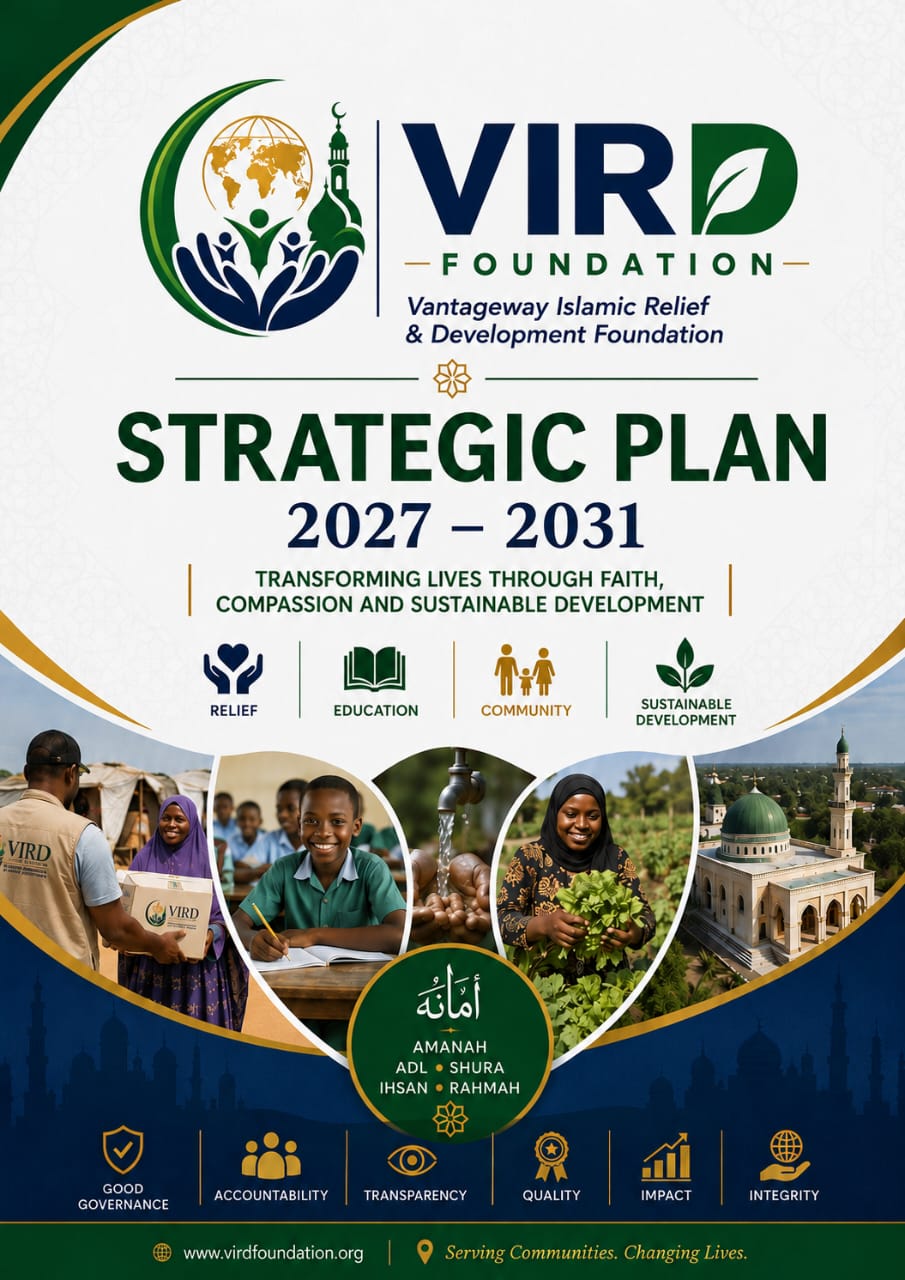
Strategic Plan 2027–2031
Transforming Lives Through Faith, Compassion and Sustainable Development
GOVERNED BY OUR PRINCIPLES
Amanah
Our institutional conduct is guided by Amanah (trustworthiness), Adl (justice), Shura (consultation), Ihsan (excellence) and Rahmah (mercy) — alongside good governance, accountability, transparency, quality, impact and integrity.
Good GovernanceAccountabilityTransparencyQualityImpactIntegrity
STRATEGIC PLAN OVERVIEW
Ten elements of our strategic direction
This page presents the strategic plan in a readable web format. The original strategic plan document remains the source of truth.
Strategic Theme
From Relief to Resilience, From Vulnerability to Opportunity.
Strategic Ambition
By 2031, to become a credible, accountable, community-centred organization with strong institutional systems, diversified funding and effective community partnerships. See "Ambition to 2031" below for the full statement.
Strategic Objectives
Twelve objectives spanning humanitarian action, essential services, food security, livelihoods, women and youth, protection, Islamic social finance, community institutions, environment, peacebuilding, institutional strength and partnerships. See "Strategic Objectives" below for the full list.
Strategic Approach
An integrated continuum connecting relief, recovery, resilience, empowerment and opportunity.
Strategic Pillars
Fourteen programme pillars spanning humanitarian assistance through research, innovation and knowledge.
Flagship Programme
VIRD BARAKA — the integrated Community Transformation Programme.
Cross-Cutting Themes
Gender equality and inclusion, disability inclusion, child protection, good governance, safeguarding and PSEA, environment and climate considerations.
Strategic Results
Improved access to services, stronger resilience, increased incomes, stronger protection systems, enhanced Islamic social investment, stronger institutional capacity, accountability and sustainability.
Implementation Framework
Governance, resourcing and monitoring arrangements that carry the plan from 2027 to 2031.
Our Commitment
Accountable, transparent and community-centred delivery throughout the strategic period.
STRATEGIC OBJECTIVES
What VIRD will work to achieve
VIRD's 2027–2031 Strategic Plan is built around these twelve objectives.
1. Humanitarian action
Save lives, protect dignity and provide timely humanitarian assistance.
2. Essential services
Improve access to WASH, health, education and nutrition.
3. Food and climate resilience
Enhance food security, agricultural productivity and climate resilience.
4. Economic opportunity
Create sustainable livelihoods and promote economic empowerment.
5. Women and youth
Advance women and youth inclusion, leadership and opportunities.
6. Protection and wellbeing
Strengthen child protection, social protection and community well-being.
7. Islamic social finance
Promote Zakat, Sadaqah, Waqf and Qard Hasan.
8. Community institutions
Strengthen mosques, Islamic education, libraries and community institutions.
9. Environmental stewardship
Build environmental stewardship and climate resilience.
10. Peace and accountable governance
Foster peacebuilding, social cohesion and accountable governance.
11. Institutional strength
Build a strong, accountable, innovative and sustainable institution.
12. Partnerships and sustainability
Maximize partnerships, resource mobilization and financial sustainability.
AMBITION TO 2031
A credible, accountable, community-centred organization
By 2031, VIRD seeks strong institutional systems; diversified, sustainable funding; effective community partnerships; demonstrated programme impact; safeguarding and accountability systems; robust monitoring, evaluation and learning; a recognized BARAKA programme; a strong Northern Ghana presence; and sustainable partnerships with government, donors, Islamic institutions, private sector and communities.
DIGITAL TRANSFORMATION
Systems that strengthen delivery and accountability
VIRD will progressively develop digital systems for programme and institutional management. Proposed platforms include beneficiary management, project management, donor relationship and grant management, a MEAL dashboard, BARAKA sponsorship, digital financial tracking and a digital asset register.
Public website services
The website is intended to be responsive and mobile-first, initially in English, search-engine optimized, integrated with social media, and capable of supporting online donations, volunteer registration, partnership enquiries, newsletter subscription and contact management.
Future digital services
VIRD Donor Portal, BARAKA Sponsorship Portal, beneficiary/community database, project and impact dashboards, online Zakat calculator, Waqf management platform, volunteer management system, and a digital complaints and feedback system.
Serving Communities. Changing Lives.